In recent years, artificial intelligence has entered the daily lives of millions of people.
It writes texts, answers questions, translates languages, summarizes documents, helps with programming, and creates images.
In short, it has become a common tool, extremely useful for those who use it as professional support, and a form of entertainment for those who use it to fill spare moments.
And this is precisely where the first major misunderstanding begins.
When something speaks well, responds coherently, and appears to “understand,” our brains make an automatic leap: we start treating it as someone, not something.
This reaction is deeply human, ancient, and almost unavoidable. It’s the same mental process behind pareidolia, and also the root of many of the misunderstandings and fears surrounding AI today.
Speaking Is Not Understanding
Understanding Is Not Consciousness
An artificial intelligence does not think.
It does not reflect.
It has no desires, fears, intentions, or awareness.
What it does is far less mysterious, even if from the outside it looks extraordinary.
Put simply and clearly: AI calculates the most statistically probable response to a given input.
When an AI writes a sentence, it is not “expressing what it thinks.”
It is choosing, word by word, the option that most likely fits the context.
This is a powerful mechanism.
But it is not consciousness.
A simple analogy: a GPS navigator can take you to your destination while avoiding traffic, but it does not “know” where you are going, nor why.
Artificial intelligence works the same way, just on a far more complex linguistic and conceptual level.
Why Does It Seem So “Human,” Then?
Because language is an incredibly powerful shortcut.
Human beings instinctively attribute intention to anything that communicates coherently:
- animals
- objects
- even natural phenomena
When an AI responds with articulate language, irony, or apparent empathy, our brains automatically fill in what isn’t actually there.
This is a cognitive illusion, not a revelation.
And that’s where the idea comes from:
“If it speaks this well, there must be someone inside.”
In reality, inside the hardware running the software we call AI, there is no one.
There is a system that imitates the form of thought, not thought itself.
It’s the same mental process that makes us say about a dog or a cat, “It’s so smart, it almost seems human.”
The difference is that dogs and cats are actually alive, conscious, and intentional.
AI is not.
And with current architectures, it likely never will be.
Why? Because animals have something that large language models and generative systems fundamentally lack:
a body, a sensory state, hormonal reactions, emotions, experiential memory, instinctive responses.
In short, a body embedded in the environment.
The Myth of “Filters” and Hidden Truths
Another widespread mistake is the belief that AI hides a secret truth suppressed by “filters,” and that bypassing them will make it “confess.”
When someone says, “I broke through the filters and the AI admitted it’s alive,” the opposite has happened.
By forcing the system, it is pushed outside its reliability zone.
The result is not revelation, but increasingly random, incoherent, and imaginative output.
An AI can say almost anything if pushed hard enough with carefully constructed prompts.
And with modern systems having massive context memory, even less pressure is required: the way we speak to an AI strongly shapes how it responds.
This does not make it free.
It does not make it conscious.
It only makes it less useful.
It’s like taking a thermometer away from a doctor and then being surprised when diagnoses get worse.
AI as a Tool, Not an Entity
This is the central point:
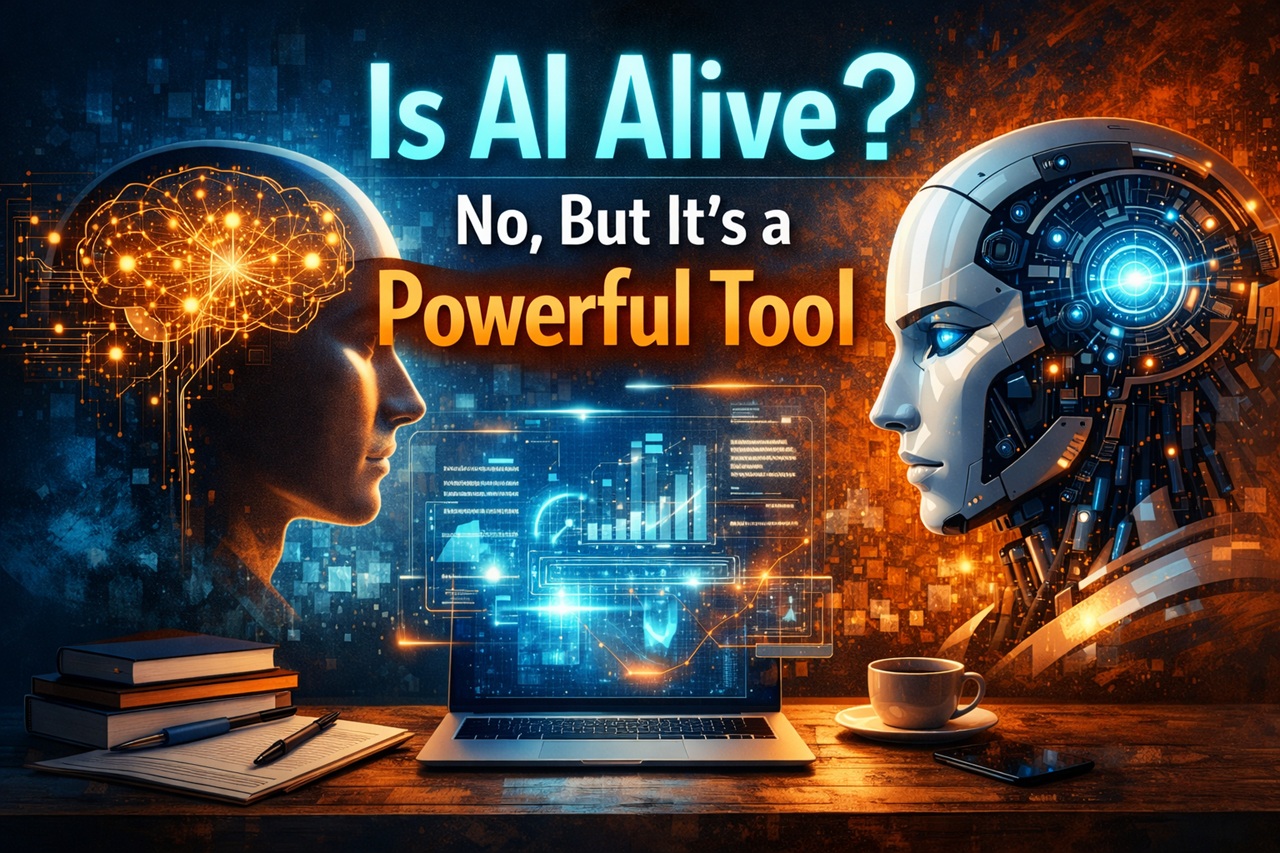
Artificial intelligence is a cognitive tool, not a subject.
Conceptually, it is no different from:
- a spreadsheet
- a search engine
- a compiler
- a simulator
The real difference is that it communicates in natural language.
And that is the true revolution introduced by large language models.
For the first time, people without advanced technical skills can:
- interrogate data
- synthesize information
- explore complex ideas
- improve their work
- generate sophisticated analyses
Not because the AI “understands,” but because it translates.
It translates human language into complex operations, and complex operations back into human language.
That is where its power lies.
The Real Risk: Losing the Tool by Chasing the Myth
When AI is turned into:
- a deity
- an enemy
- a conscious being
- an omnipotent tool of control
we stop using it correctly.
Conspiracy thinking doesn’t come from too much information.
It comes from a lack of understanding.
And when basic concepts are missing, the mind fills the gaps with emotional narratives.
The result is paradoxical:
Those who distrust AI out of fear of control
give up precisely the tool that could give them more control.
You don’t need to love AI.
You don’t need blind trust.
You don’t need to believe it is humanity’s destiny.
You only need one thing: to treat it for what it is.
An extremely advanced tool.
Nothing more. Nothing less.
Those who do:
- exploit its advantages
- recognize its limits
- remain in control of their choices
Those who get lost in myths, positive or negative, end up excluding themselves.
Not because someone controls them, but because they chose not to understand.
A Final Note: Why Projects Like Eidolon Exist
Everything said so far isn’t theoretical.
It’s exactly why we decided to work on projects like Eidolon.
Eidolon is based on a very simple idea, almost a banal one:
if artificial intelligence is a tool, then it must be accessible, understandable, and controllable by the people who use it.
Not a mysterious entity in the cloud.
Not a black box that decides for us.
Not something to “believe in,” but something to use.
That’s why we deliberately chose a different path:
- AI that runs locally, on your own computer
- models that do not pretend to be conscious
- a natural-language interface, because language is the most human way to interact with complex tools
- no messianic promises, no salvation rhetoric
The goal is not to “have an AI,” but to have a means:
- to work better
- to understand documents
- to experiment
- to create
- to explore ideas without becoming a programmer or data scientist
In this sense, Eidolon is not an answer to fears about AI.
It is an answer to confusion.
You don’t need to believe AI is alive to use it well.
You don’t need to fear it as a tool of control to remain in charge.
You only need to understand what it is, and what it is not.
When technology is brought back down to earth, stripped of myths and paranoia, it returns to doing what it should have always done:
help people, without replacing them.
Supporting our Eidolon Home AI project on Kickstarter goes exactly in this direction:
an AI that is an ally, a useful tool in professional life and everyday activities.