Artificial Intelligence exploded thanks to cloud giants like OpenAI, Gemini, Claude, and others. But a strong counter-trend is emerging: more and more companies and individuals now want local AI models running directly on their own machines, with no reliance on external servers, subscriptions, or corporate policies.
And it’s not hard to understand why. Cloud-based AI comes with privacy concerns, data-security risks, and a long list of recurring costs: monthly or yearly subscriptions, token packages, or pay-per-use models for accessing more advanced features.
In other words, “Local AI” is no longer a niche for hobbyists. By the end of 2025, it has become a global movement.
The Limitations of Cloud AI
Cloud AI offers convenience, but it also brings constraints and risks that many users are no longer willing to accept:
• Privacy: Your data passes through servers you do not control, often in jurisdictions with different privacy laws.
• Recurring costs: Free tiers are heavily limited: a few queries per day, a handful of images or video generations.
Real usage requires paid plans, token bundles, or pay-per-use pricing.
• Total dependency: If the platform changes policy, shuts down, or experiences a network issue, your workflow collapses.
Businesses can’t afford that level of fragility.
• Arbitrary restrictions: Filters, censorship, model limitations, and geo-blocks often prevent legitimate use cases.
• Latency and instability: Even the largest platforms have “bad days” with slowdowns, errors, timeouts, or degraded performance.
The Technological Leap of Local Models
2025 has seen an explosion of increasingly powerful open-source models.
Interestingly, many are released by big tech companies themselves: intentionally limited versions of their internal systems, used to gather real-world feedback from developers and researchers.
Models like:
- Gemma 3
- GPT-OSS
- IBM Granite
- DeepSeek
- Qwen
represent the state of the art in open-source AI.
At the same time, quantization techniques have advanced dramatically. Formats such as Q4_K_M and Q5_K_S reduce memory requirements to the point where these models can run on ordinary consumer hardware.
Tools like Llama.cpp make it possible to run them on modest CPUs or GPUs, across Windows, Linux, and macOS.
The result?
Models with tens of billions of parameters can now run on €400–€800 PCs — something unimaginable just a couple of years ago.
Real examples:
- GPT-OSS 20B, delivering high-quality conversational performance
- Gemma 3 VLM, performing offline image analysis
- Wan2GP, SVD, Flux, generating video locally
This is not theory. It already works.
Why This Revolution Is Irreversible
Once people experience the freedom of “local-first” AI — myself included — it becomes very hard to go back to cloud subscriptions.
The reasons are straightforward:
• Open-source communities evolve faster than proprietary platforms
• Hardware costs continue to shrink
• Companies are showing growing interest in private AI for security and compliance
• The only major bottleneck left is training cost — and even that is changing
We are witnessing the birth of a new standard.
A Practical Example: What a Local AI Hub Can Do
To make this shift clearer, let’s look at a concrete example: Eidolon AI Hub, a local AI ecosystem I know extremely well because it was developed in-house.
Eidolon AI Hub allows you to:
- run multiple models for chat, images, video, and music
- keep everything stored physically on your machine
- avoid tracking, subscriptions, and artificial limits
- work effectively as a creator, journalist, writer, analyst, researcher, or developer
- carry the hub on a USB drive or portable SSD and use it on any computer
Its flexibility comes from a simple fact: it does not depend on the cloud.
Conclusion
2025 will be remembered as the year when Local AI stopped being an alternative and started becoming the default choice.
Offline AI has finally become a democratic tool — affordable, private, powerful, and fully in the user’s control.
The future of artificial intelligence is no longer locked in distant data centers.
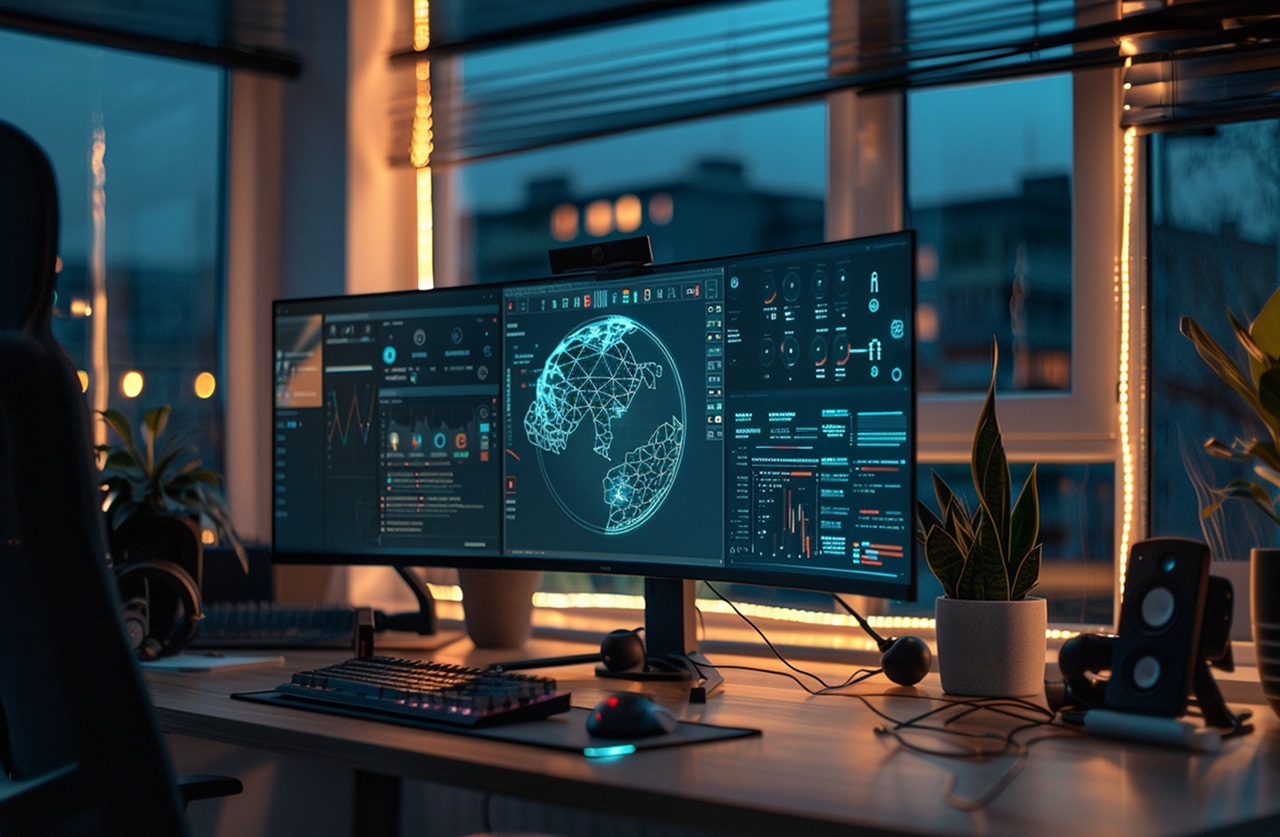
It sits on the computer on your desk.